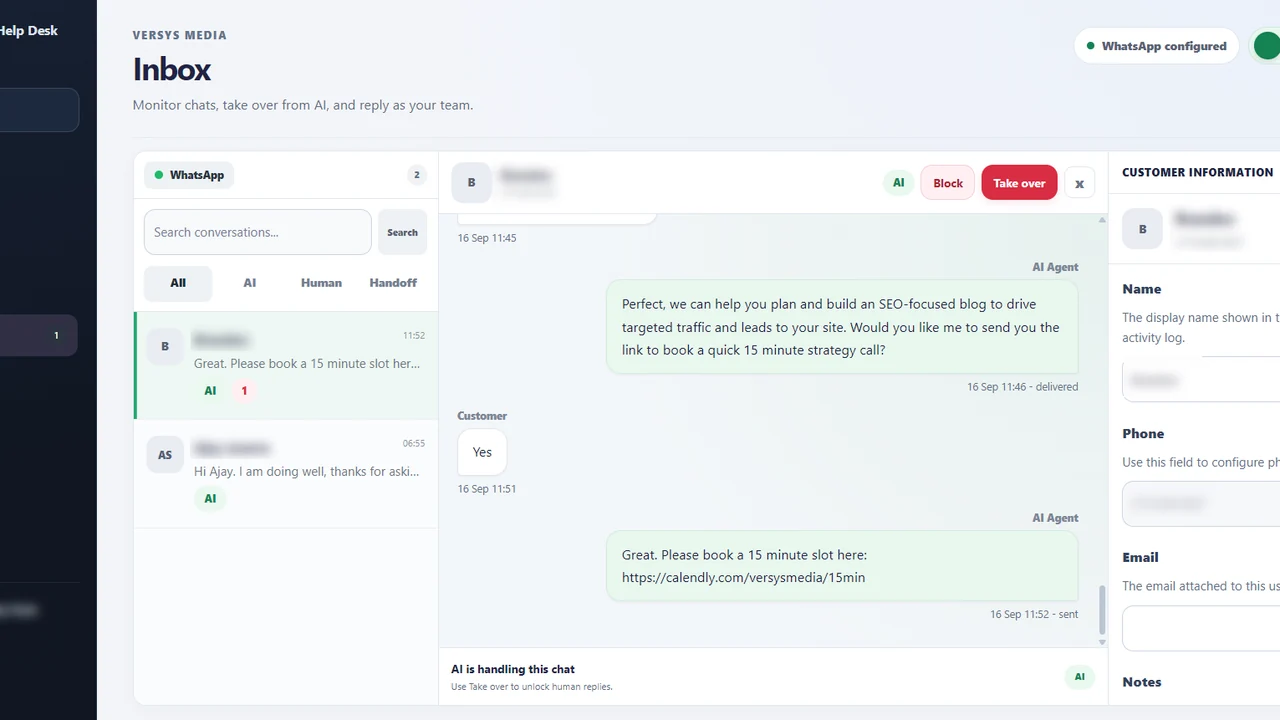
An AI support dashboard can show attractive numbers without proving that people received help. A high AI-reply percentage is not the same as a resolved customer problem. Use a short scorecard that measures queue health, escalation quality and the customer outcome, then connect each number to an action your team can take.
Metric 1: Time to first meaningful response
Measure the time from an incoming customer request to a useful answer or an acknowledged next action. Separate business-hours and after-hours cases so the comparison stays fair. An automated greeting does not count as a meaningful resolution if the customer still has no idea what to do next.
Look at the median as well as unusually slow cases. Averages can conceal a small group of customers left waiting for days. If first response is slow, review notification routing and ownership before blaming staff effort.
Metric 2: Open conversations past the expected window
Count unresolved cases that exceed your published response or follow-up target. Review them by status: waiting for a customer, waiting for internal action or blocked by a system issue. Not every open conversation is late, but every late one needs an accountable next step.
A weekly ageing report is often enough for a small operation. Assign the oldest items first and verify whether a previously marked "resolved" case was closed merely to improve the dashboard.
Metric 3: AI-to-human handoff quality
Track how often automated support transfers to a person and why. A high transfer rate is not automatically bad. Sensitive or complex questions should go to staff. The quality question is whether transfer happened at the right moment and gave the employee enough context to continue.
Review examples where the bot repeatedly asked the same question, failed to recognize "human please" or continued sending automated messages after takeover. Fix these workflow errors before expanding what the agent is allowed to answer.
Metrics 4 and 5: Repeat contacts and reopened cases
A customer returning about the same unresolved issue is a stronger warning than a low agent-usage number. Track repeat contact within a defined period and reopenings after the team considered the issue solved. Exclude legitimate separate requests so the indicator is not inflated by active customers.
When repeat contacts rise, inspect whether the knowledge answer was incomplete, an action was never completed, or staff ownership changed halfway through. These explanations point to different fixes; a single generic "improve AI" instruction does not.
Metric 6: Approved automation outcomes
Define narrow, verifiable outcomes such as a correct policy answer confirmed by review, a customer callback request routed successfully or an appointment confirmed by an integrated system. Count only outcomes supported by evidence. Do not automatically label a conversation successful because it ended without a human reply.
Start with a one-page weekly report and one improvement action per metric. The Help Desk overview explains the kinds of reporting and handoff controls available. Pair this with the small-team triage playbook to make the numbers operational.
Example: build the scorecard from actual conversations
Take a hypothetical week with 120 inbound conversations. Suppose 25 needed human help, 8 exceeded the response target, 12 returned about the same issue and 3 were incorrectly marked resolved. Those numbers are not benchmarks; they are an example of what an operations review could surface. The key is to open the underlying cases instead of treating the percentages as a verdict.
For the eight overdue cases, ask which had no owner, which were blocked by a system error and which were waiting on the customer. For repeat contacts, check whether the approved knowledge answer was incomplete. For incorrect closures, adjust the definition of resolved and require evidence that the next action was completed.
Agree on a baseline first. Changing staff hours, channel mix or customer volume can change metrics without indicating a process failure. Track trends consistently and add short case notes explaining the most important changes. One accountable improvement per week is more valuable than a beautiful dashboard with no follow-through.
Takeaway checklist
- Track meaningful replies, not only greetings.
- List ageing conversations by accountable owner.
- Audit a sample of AI-to-human transfers.
- Review repeat contacts and reopened cases together.
- Count only evidence-backed automated outcomes.
What to do next
Choose one improvement you can complete in the next working week. Write down who owns it, what evidence will show it is working, and how you will check again after rollout. A small, well-tested change is more useful than adding features nobody monitors.
For hands-on help with a business-specific workflow, explore Versys Media or the Versys Apps directory. Bring the process you want to improve, not just a request to add AI everywhere.